Trigeneration / CCHP
Gain better efficiency and lower emissions with a Jenbacher combined cooling, heat, and power (CCHP) system.
CHP and CCHP solutions are widely used in various applications and industries. They provide an efficient, highly secure energy supply as well as independence from the grid.
Our dedicated Jenbacher experts are available to provide personal consultation.
What is trigeneration / CCHP?
Combine your cooling, heat, and power by bringing together a cogeneration plant and absorption chillers in one high-efficiency, low-emission system.
Cogeneration—or combined heat and power (CHP)—systems can offer efficient power and heat with low emissions, while absorption chillers provide an economical and environmental alternative to conventional refrigeration using compression chillers. Combining these elements as a trigeneration plant enables excellent total fuel efficiency, elimination of HCFC/CFC refrigerants, and reduced overall air emissions.
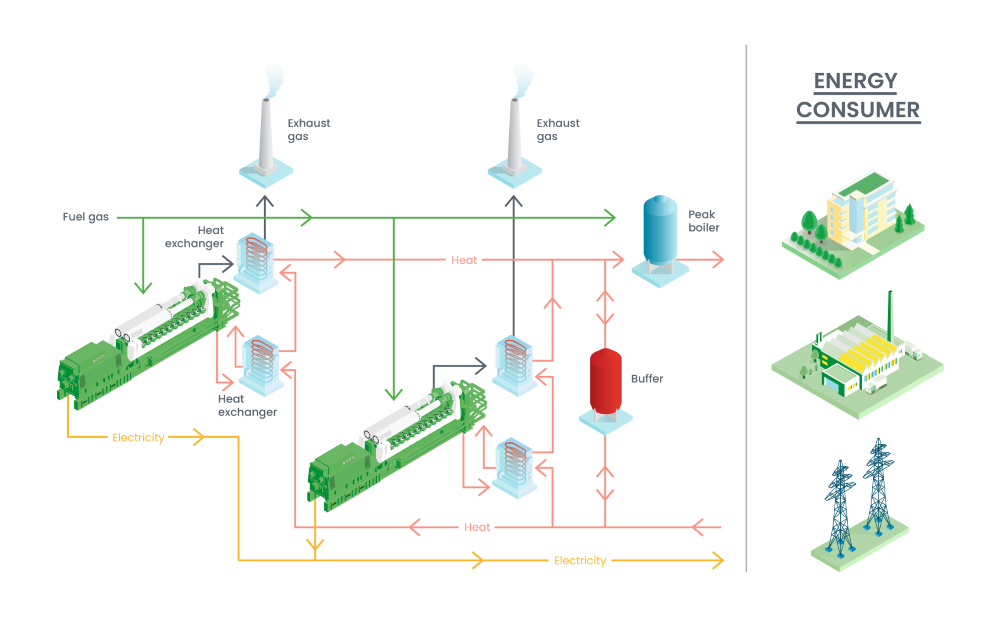
A powerful engine portfolio
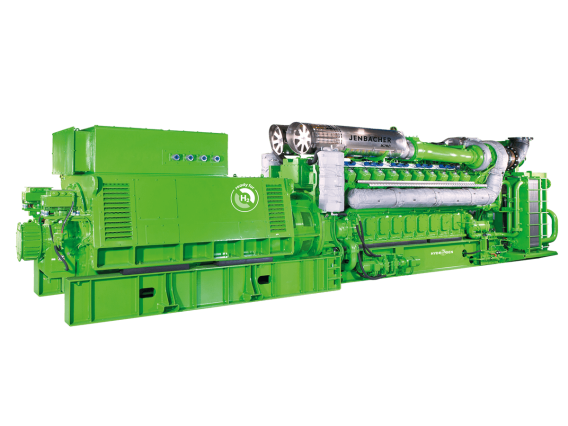
INNIO offers you a comprehensive portfolio from 250 kW up to 10.6 MW of single unit electrical power output. By using multiple CHP and trigeneration systems in one plant, the power output can be scaled up while part load performance and reliability are increased.
Benefits of CCHP solutions

- Improve cooling efficiency and reduce costs with absorption-based systems for air conditioning, which are more efficient and economical in producing low NOx emissions compared to conventional refrigeration technology
- Meet your heating requirements by harnessing the available “excess energy” as part of the trigeneration system
- Use produced electricity to cover your plant’s power requirements or feed it into the public grid
- Reduce your maintenance expenses and increase intervals between overhauls with simple, high-quality construction, with no moving parts
- Support noiseless operation
- Receive the flexibility of dual fuel capability
- Reduce your operating and life-cycle costs
- Eliminate use of ozone-damaging substances by using water as a refrigerant
Experience our webinar: Learn about our CHP solutions
Jenbacher North American team invites you to review the recording of our recent webinar, to learn how Jenbacher can help you develop your power plant projects, including equipment design and performance, using hydrogen and much more! In the webinar, you will learn more about:
- Overview of an independent power plant and its components
- Jenbacher’s highly efficient type 6 genset
- Our hydrogen power generation solutions
- How proven equipment design improves performance
- Power generation solutions with quick delivery and easy installation
The information provided is relevant for the North American market. Please reach out to our experts to discuss your project.
Our experts are ready to help you
Whether your business is looking for onsite power solutions, access to electricity, decreased energy costs, or even to sell electricity back to your local grid/consumers, Jenbacher´s regional experts can advise you on which solution makes the most sense for you.
Get in touch for free consultation on the following:
- The benefits of onsite power generation solutions for your company
- Potential financial benefits using economic modeling
- Consultation on the technical side of your project – fuel types, feasibility studies, equipment and balance of plant selection, and more
- Regional incentive programs relevant to your business
- Options to deliver your project: purchasing, financing and leasing, engaging a service provider (ESCO, BOO etc.)
- How to meet emissions targets
Fill-in contact form, or send us an email contact.en@innio.com.
Frequently Asked Questions
Why do data centers and hospitals use trigeneration?
CCHP power plant (also called a trigeneration power plant or combined cooling heat and power (CCHP) system) suits facilities with continuous power needs alongside significant cooling, such as data centers and hospitals.
How does an absorption chiller use recovered heat?
An absorption chiller uses recovered thermal energy to drive the cooling process, reducing the electrical power required for conventional mechanically driven cooling. The specific working fluids depend on the selected absorption-chiller technology.
Can an existing CHP system be upgraded to trigeneration?
In many cases, yes — an absorption chiller can be added to an existing CHP plant to use currently unused heat for cooling, effectively converting it into a trigeneration system. Feasibility depends on the plant’s existing heat recovery capacity and the site’s cooling demand.
How much can trigeneration save compared to running separate power, heat, and cooling systems?
It depends on the gap between what you pay for fuel and running the plant, versus what you’d otherwise pay for grid electricity, heating fuel, and cooling separately. The wider that gap, the stronger the case. Facilities with steady, simultaneous demand for all three tend to see the best results, since less generated capacity goes unused.
What size facility is trigeneration best suited for?
Trigeneration tends to make sense for facilities with meaningful, fairly constant cooling needs alongside power and heat demand, such as hospitals, data centers, and larger commercial or industrial sites. Smaller sites with light cooling needs may not see the same benefit.
Is trigeneration a good option for hot climates with high cooling demand?
Yes, trigeneration can be especially valuable in hot climates because the recovered heat that would otherwise go unused can instead drive an absorption chiller to meet a large cooling load. This improves overall fuel utilization compared with cogeneration alone.
Consult an expert
Send us a message and we’ll contact you to start the conversation.
Whether your business is looking for onsite power solutions, access to electricity, decreased energy costs, or even to sell electricity back to your local grid/consumers, Jenbacher regional experts can advise you on which solution makes the most sense for you.